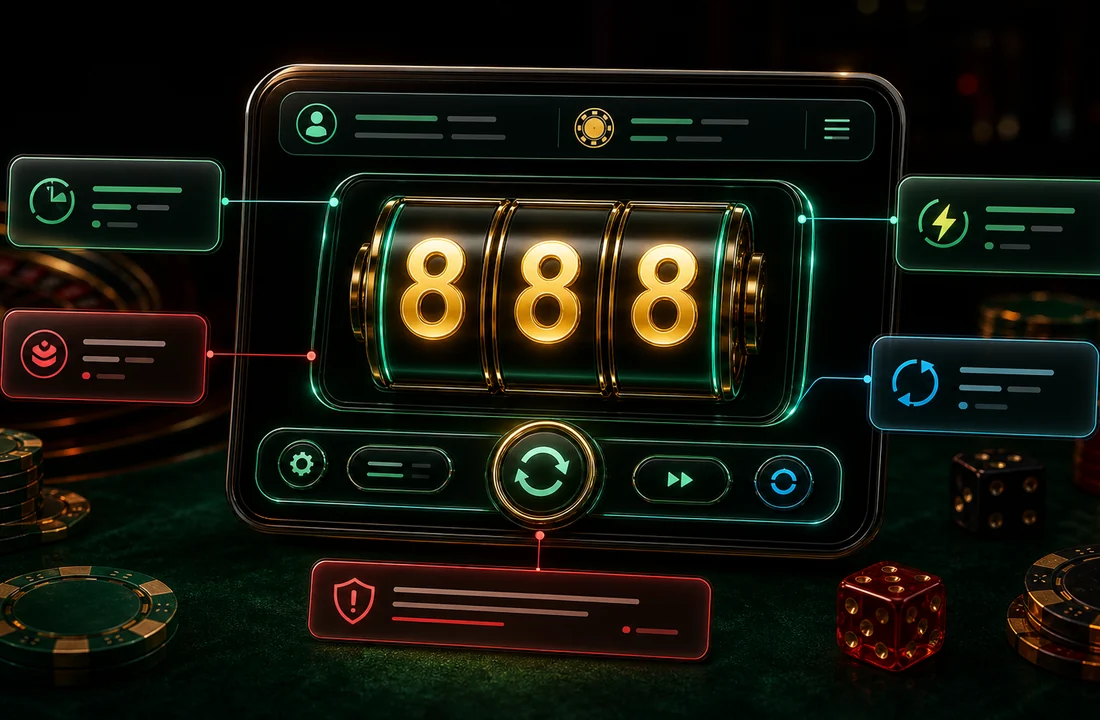
Before you tap inside a slot-style room, slow the screen down with your own checking order. The most useful order is simple: read the room label first, check the timer area, look at the button state, then deal with any phone prompt or login message. This order helps you avoid reacting only to bright reels, flashing buttons, or short messages that disappear before you have understood them.
This page is for adults in India who want a calmer way to read mobile slot-style screens. It is not a game instruction, payment guide, cash-out service, or result claim. The focus is only on visible screen checks: room labels, timers, button state, phone prompts, login prompts, balance display, warning messages, and adult caution.
Start with the room label before touching the button
The room label is your first anchor. If you do not clearly know which room card or room screen you are looking at, do not let the button decide for you. A glowing button can pull attention away from the room name, but the label is where your check should begin.
- Pause on the room screen before tapping any control.
- Read the room label fully, not just the largest or brightest part of the card.
- Check whether the label matches the room you intended to open.
- If the label is hidden, cut off, moving too quickly, or mixed with another screen effect, wait or step back.
A useful habit is to keep your finger away from the main control until the room label is clear. If the label and the visible screen do not match what you expected, that is enough reason to stop. You do not need to prove that something is wrong before pausing; uncertainty is already a reason to slow down.
Check the timer area before judging the button
After the label, look for the timer area. A timer signal can make a screen feel urgent, especially when reels or room cards are animated. Your job is not to beat the timer. Your job is to understand whether the screen is asking you to wait, continue, or avoid tapping during an unclear state.
Read the timer area as a separate field. Do not combine it with the button, balance display, or reel movement. If the timer area changes quickly, watch one full change before deciding what the button might mean. If the timer is unclear, treat the whole screen as unclear.
- Clear timer area: you can see where the timing signal is and can separate it from other effects.
- Unclear timer area: the timing signal is hidden, moving too quickly, or mixed with animation.
- No readable timer: do not assume the screen is safe to tap just because a button is visible.
This is not about predicting a result. Timer signals do not prove access, safety, or outcome. They are only one part of a screen check before you decide whether to continue.
Read the button state only after label and timer
The button state should be checked after the label and timer because buttons are designed to invite action. A button may look active, inactive, paused, or ready to continue, but the visual style alone is not enough. You need to see it in context.
- Confirm the room label is the one you meant to inspect.
- Check whether the timer area is readable.
- Look at the button without tapping it.
- Ask whether the button state matches the rest of the screen.
- If the button seems to pressure you while the label or timer is unclear, do not continue.
The main mistake is reading the button first. If you start with the brightest control, you may miss a warning message, a session note, or a phone prompt. A button is not proof that the room is suitable for you, that a round is valid, or that any result is certain. It is only a visible control on a screen.
Use a fixed order when a phone prompt appears
Phone prompts can interrupt a screen check. They may relate to device permissions, app prompts, lock cues, age reminders, login notes, number entry, password entry, OTP entry, or session messages. When a prompt appears, stop reading the slot screen and read the phone prompt first.
Do not tap through a prompt just to get back to the room. A prompt can change what you are being asked to do. It may also cover the timer, button state, room label, or warning message. If part of the screen is covered, your check is incomplete.
- Stop before tapping any visible button behind the prompt.
- Read the prompt type: permission, login, OTP, password, session, lock cue, or age reminder.
- Check whether the prompt is connected to the action you just took.
- If you cannot connect the prompt to your own action, do not continue.
- Never share OTP codes or private login details with strangers because a screen or message creates pressure.
A phone prompt should not be treated as a small interruption. It is part of the decision. If the prompt is unclear, the correct response is to pause rather than continue under pressure.
Specific check example: button first looks ready, then a prompt appears
Assume you open a slot-style room card and see a bright control on the screen. The room label is partly visible, the timer area is changing, and a phone prompt appears before you tap again. In this situation, do not follow the button. Follow the order.
- Move attention away from the bright control.
- Read the room label again and confirm whether it is the room you meant to inspect.
- Look at the timer area and decide whether it is readable or too unclear.
- Read the phone prompt without entering private details automatically.
- Check whether the prompt relates to number, password, OTP, session, permission, lock cue, or age reminder.
- If any field is unclear, exit the action path rather than tapping through.
This example does not assume any result, payment, or game mechanic. It only shows how to handle a real screen-reading problem: a button looks ready, but the surrounding fields have not been checked. The safer decision is to complete the check or stop.
Balance display and warning message come before any pressured tap
If the screen shows a balance display or warning message, read it before acting on a button. A balance display should not be treated as a promise, and a warning message should not be ignored because reels are moving. These fields may be quieter than the main control, but they are part of the screen you are choosing to trust.
Use a simple rule: if a warning message appears, the button waits. If a balance display is unclear, the button waits. If the phone prompt asks for sensitive information and you are not sure why, the button waits. Nothing on the screen should rush you into sharing OTP codes, continuing a session you do not understand, or moving past a caution signal.
Login prompts need extra care
Login screens can include number, password, OTP, and session messages. Treat these as private decision points, not routine taps. A slot-style screen may feel casual, but login fields are not casual. They connect to access and account control.
- Check whether you meant to reach a login screen.
- Do not enter details because another screen effect makes the action feel urgent.
- Do not share OTP codes with anyone outside your own device flow.
- If a session message is unclear, stop and review the screen from the beginning.
If a login prompt appears unexpectedly, return to the same order: label, timer, button state, phone prompt, then login meaning. Do not reverse the order just because the prompt is in front of you. The more urgent the screen feels, the more slowly you should read it.
Adult caution: what this check can and cannot do
This checking order can help you notice unclear labels, unreadable timers, mismatched button states, covered screens, login prompts, and phone prompts before you act. It can also help you resist pressure from fast animation or bright room cards.
It cannot prove that a game is safe, that access is valid, that a result will occur, or that any payment or cash-out request is genuine. It also cannot replace your own judgement when a screen asks for money, private details, OTP codes, or continued action under pressure. If the screen asks you to move money or trust a result, this check does not verify that claim.
A short checklist before you continue
- Room label: can you read it clearly?
- Timer area: is it visible and separate from animation?
- Button state: does it make sense after reading the label and timer?
- Phone prompt: do you understand why it appeared?
- Login note: are number, password, OTP, or session messages expected?
- Balance display: is it clear, or is it being used to rush you?
- Warning message: have you read it before tapping?
If one answer is unclear, pause. A slower check is not a delay; it is the point of the process. Slot-style screens can move quickly, but your decision does not need to move at the same speed.
Responsible play reminder
This article is informational only. It does not provide account service, payment handling, outcome prediction, or any guaranteed result. Adults should check local rules and keep play recreational.