
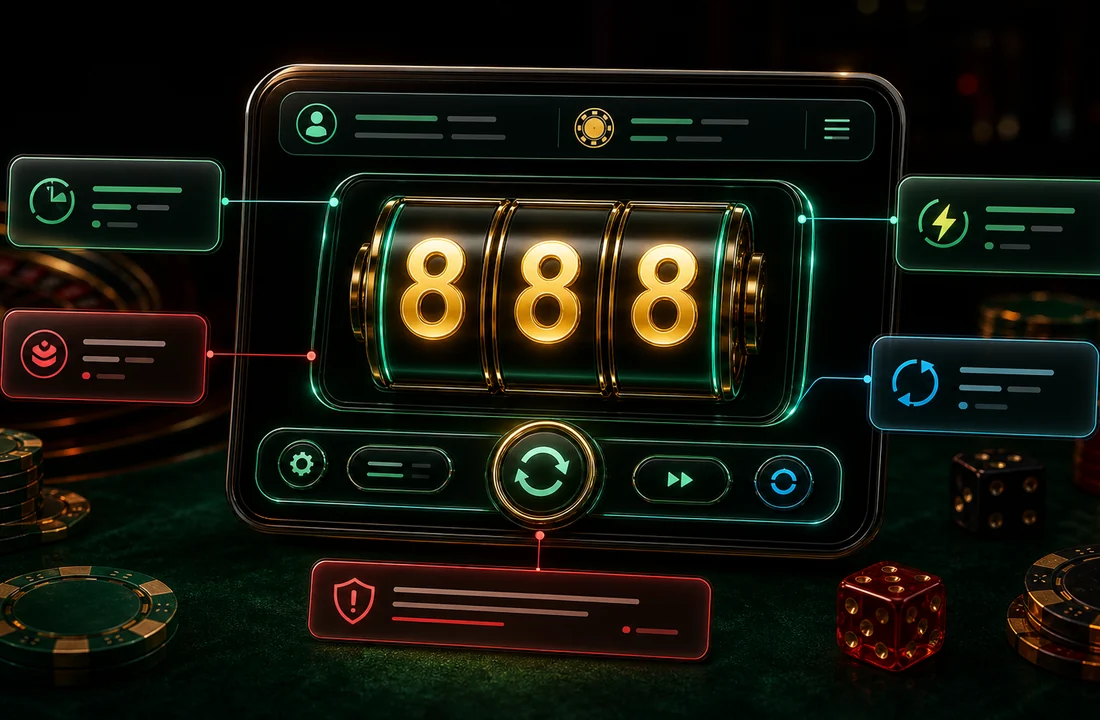
A room label and a timer may appear close together on a slot-style screen, but they answer different questions. The room label helps you identify the screen you are viewing. The timer shows a timing signal connected with that screen. Reading them as if they were the same field can make a fast page feel more confusing than it needs to be.
Use a separate check for each one before you continue. First read the room label without pressing the spin control. Then look at the timer area and notice whether its display is clear enough to understand. Only after these two checks should you review the button state, phone prompts, balance display, and warning messages. If any part is unclear, pause instead of relying on bright effects or moving reels.
Start with the room label
The room label is the screen’s identifying text. It should be read before you treat the room as the one you intended to inspect. Do not use the colour of the room card, a glowing reel, or a large control as a substitute for the label. Visual design can attract attention, but it does not confirm what the screen represents.
- Place your attention on the room label before looking for an action control.
- Read the complete visible label at a normal pace.
- Check whether the wording is clear or partly hidden by another phone element.
- Compare the label with the room you meant to review.
- If you cannot identify the room, stop at this stage and do not continue from the uncertain screen.
This check is about identification, not timing. A label does not tell you that a round is active, that a control is ready, or that any result is available. It only helps you understand which room screen is in front of you. Keeping that distinction in mind makes the rest of the review more orderly.
Check the timer separately
After reading the room label, move to the timer area. Treat the timer as a separate screen signal. Look at whether it is visible, readable, and connected to the room view you have just identified. Avoid guessing what a changing display means. A timer can draw attention because it changes, but movement alone is not proof that you need to act immediately.
- Confirm that you are still looking at the same room screen.
- Find the timer area without pressing the spin control.
- Read the displayed timing signal as far as the screen allows.
- Notice whether the timer is clear, partly covered, or difficult to interpret.
- Pause if the timing signal creates pressure or does not make sense.
The timer check should not replace the room-label check. A timer may be changing while the room identity remains unclear. Equally, a readable room label does not explain what a timer display means. Record these as two separate observations in your own mind: room identified, timer understood or not understood.
A simple two-column way to think
When the screen feels busy, use a short mental separation. For the room label, ask, “Which room screen am I viewing?” For the timer, ask, “What timing signal can I actually read?” Do not answer the second question by guessing from the first. This prevents a familiar-looking room card from making an unclear timer seem trustworthy.
A useful check can be written as two lines:
- Room label: clear, partly hidden, or not understood.
- Timer: readable, changing but unclear, or not visible.
This is a checking method, not a claim about what a screen will display. The page may present different visual arrangements, and the available information may not be enough to explain a timer fully. The purpose is to slow your reading and keep identification separate from timing.
Hypothetical example
Suppose a hypothetical screen shows Room A as the visible room label, while the timer area is changing and the spin control appears ready. Your first note would be: “Room A is identified.” Your second note would be: “The timer is changing, but its meaning is not confirmed.” You should not turn those two observations into a conclusion that the room is safe, available, or likely to produce any result.
If the hypothetical timer is partly hidden by a phone prompt, read the prompt before making another decision. The label may still be readable, but the timer is no longer fully available for checking. In that situation, the correct action is to pause and review the screen rather than use the visible room name as a reason to continue.
Review the button state after both checks
Once the room label and timer have been considered separately, look at the button state. The control may appear active or inactive, but its appearance does not prove that you understand the room or the timing signal. A ready-looking control should not override an unclear label, a covered timer, or a warning message.
Use this order:
- Read the room label.
- Review the timer area.
- Look at the button state.
- Read any warning label.
- Check the phone prompt before sharing any private detail.
Keeping the control until the third step helps prevent an urgent-looking screen from controlling the pace of your decision. Bright effects, flashing buttons, and 888-style reels can make a room seem active, but they do not establish access, safety, or an outcome.
Include phone prompts in the pause check
Phone prompts can interrupt your reading of both the label and the timer. If a prompt appears, first note which part of the screen it covers. Then read the prompt without sharing private details with strangers. Login-related messages may refer to a number, password, OTP, or session. The presence of a prompt does not by itself confirm that it should be followed.
If you are unsure what a phone prompt is asking, keep the room and timer review unfinished. Do not treat a prompt as a reason to rush. The screen should remain understandable before you decide whether any further action is appropriate. A pause is especially important when the prompt asks for an OTP code or when someone pressures you to continue.
For a related explanation of separating screen elements before acting, read Slot Screen Checks for India: A Button and Phone Prompt Order. For another focused check of room labels, timer areas, and controls, see Slot Button State and Phone Prompt Checks for India.
Use warning messages as a stopping point
A warning label should be read rather than dismissed. If it appears while you are checking the room label or timer, return to the last part you understood and continue only if the screen becomes clear. Do not assume that a warning is unimportant because the button state looks ready.
Also review the balance display without treating it as proof of a payment service or a result. The page does not run games, take payments, handle cash-out requests, or promise results. If a screen asks you to move money, provide an OTP code, or continue under pressure, slow down and check where the prompt came from.
When the checks cannot settle the question
These checks have a clear limit. A readable room label and a visible timer cannot prove that a screen is safe, that access is available, or that any result will follow. They only help you read the visible interface in a more controlled order. They also cannot explain a prompt that is missing, covered, or too vague to understand.
Do not fill gaps with assumptions. If the label is unclear, the timer is confusing, the button state conflicts with a warning, or a phone prompt demands private information, stop the review. You can leave the screen without making a decision. Adults in India should treat unclear prompts and pressure to act as reasons for caution, not as signals to hurry.
Final room-and-timer checklist
- Read the complete room label first.
- Decide whether the room identity is clear.
- Check the timer area as a separate field.
- Note whether the timer is readable or unclear.
- Review the button state only after those two checks.
- Read warning labels and phone prompts carefully.
- Do not share private details with strangers.
- Pause when the screen creates pressure or asks for money.
- Remember that screen effects do not prove access, safety, or results.
A slower room-and-timer check gives you a practical way to read a fast slot-style screen without confusing identification with timing. It does not turn an unclear screen into a reliable one. When the visible information is incomplete, the safest conclusion is simply that the check is incomplete.
Responsible play reminder
This article is informational only. It does not provide account service, payment handling, outcome prediction, or any guaranteed result. Adults should check local rules and keep play recreational.